
| |

How Does Infrared Thermography Work?
 |
|
This is intended as a general description of infrared
thermography. It provides the basic understanding necessary to appreciate the importance of infrared
thermography, this web site, and IR images in general.
You can find highly technical descriptions of
infrared technology on any number of other web sites. (In fact, you'll
find some by visiting our Infrared Links
page. Trade magazines and technical societies are also a great
resources for learning about infrared thermography.
About the Infrared Camera Colorizing
Infrared Images Adjusting Images for
Clarity
Return to Home Page
|
| Infrared
thermography is the technique of converting infrared energy (radiant heat)
into an image that a person can see and understand.
We ordinarily see in visible light. We can compare infrared to
visible light - they are not the same, but they are analogous. |
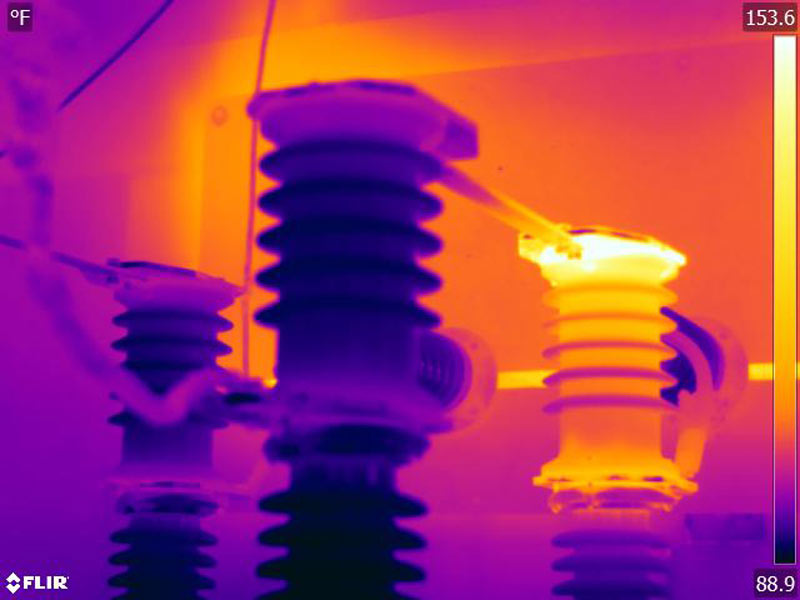
This infrared image may look
"odd" because you ordinarily see in visible light. This
image shows the radiant heat rather than light. The light areas are
warmer than the dark areas. Notice the temperature scale to
the left of the picture.
|
| You are familiar with the idea
of a video camera creating images on video monitors or television.
The electronics in the camera convert the light energy that enters the
lens into a video signal, and displays that signal on a monitor or TV.
You see shapes, colors, textures, shadows, and reflective surfaces in the
image as a result of the camera's ability to capture light. |
| This
image of shows a hot coffee mug and a plate of cookies. This image
has been enhance by adding color. As you can see, the colors bear no
correlation with visible light, rather the colors correspond to the
radiant heat. Notice the temperature scale to the left of the image.
|
In a similar way, an
infrared camera creates an image by converting radiant heat energy into a
signal that can be displayed on a monitor (and later printed).
The infrared energy emitted
from an object is directly proportional to its temperature. Therefore
temperatures are accurately measured by the infrared camera.
|
| The
ability to measure temperature from an IR image is called radiometry.
This requires sophisticated and expensive electronics. The ability
to measure a temperature anywhere on the image is available only on the
high-end cameras like the Flir PM280 used by IRIS
Associates. |
|
|
About
the Infrared Camera
 |
|
The first portable infrared cameras designed for
field use came on the market about 25 years ago. We owe much to the
pioneering engineers and technicians who used them and immediately
established their value as a tool for better production and maintenance.
Unfortunately these first systems, although portable,
were physically large, heavy, and relatively cumbersome. The camera's
temperature analysis capabilities were limited, and the only permanent
image was a photographic image captured from the screen. No later
adjustments for clarity could be made.
|
The Flir PM280 used by
IRIS Associates stores 12 bit images on a PC card. On-line features
enable instant analysis of an image. Powerful software analysis tools
enable a more thorough examination after the survey.
|
|
Fortunately the demand for better instruments has led
to continuous technological improvements. Modern infrared imagers
are compact, rugged, lightweight, versatile, and store 12 bit dynamic
range images (which enable adjustments similar to brightness and contrast
in video images).
|
|
|
Colorizing Infrared Images

|
|
Black and white, and color, are
properties of visible light that do not exist in the infrared world.
Because we need to convert these images into visible light, the IR camera
assigns black to the coolest temperatures in an image, white to the
hottest temperatures in an image, and graduating shades of gray in
between. Similarly, different colors can be used to portray
different temperatures.
Using colors to represent different temperatures, a knowledgeable
technician adjusts the color image to optimize clarity and best reveal the
high temperatures of interest.
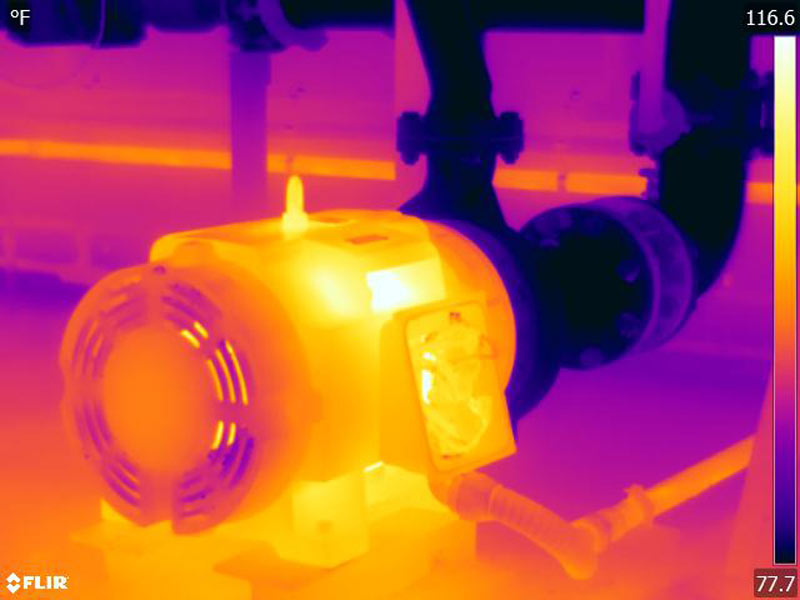
While the same technical information can be drawn from the four images
on the right, you can see that the same image colored with 4 different
palettes, appears quite different.
The same picture of the same
building appears here in B/W and in different color palettes.
|
|
|
 |
|
|
|
|
Adjusting Images for Clarity
 |
|
One of the benefits of 12 bit dynamic range
technology is that the upper and lower temperature limits visible in the
image can be adjusted to get the clearest picture.
Compared to a video image, the temperature span
is comparable to contrast, and the levels of temperature within the span
are comparable to brightness.
Here are four versions of the same thermograph.
The first is the black and white version created by the IR camera.
The other three have been colorized with the same color pallet. The
upper and lower temperature limit has been
adjusted in each of the three images. |
This is a ladle transfer car, used
to move hot metal from a blast furnace to a basic oxygen furnace. IR
is commonly used to monitor the outer temperature of these cars to detect
hotspots. This helps guard against hot metal breakouts.
|

|