
|

|
Frequently Asked Questions
 |
What
is infrared thermography and how does it work?
Infrared thermography is the technique of converting
infrared energy (radiant heat) into a picture.
This is analogous to photography which turns light into a picture.
An infrared imaging camera, which looks similar to a video camera,
“sees” the radiant heat through the lens and the internal electronics
converts the heat patterns into a signal that is displayed on a normal video
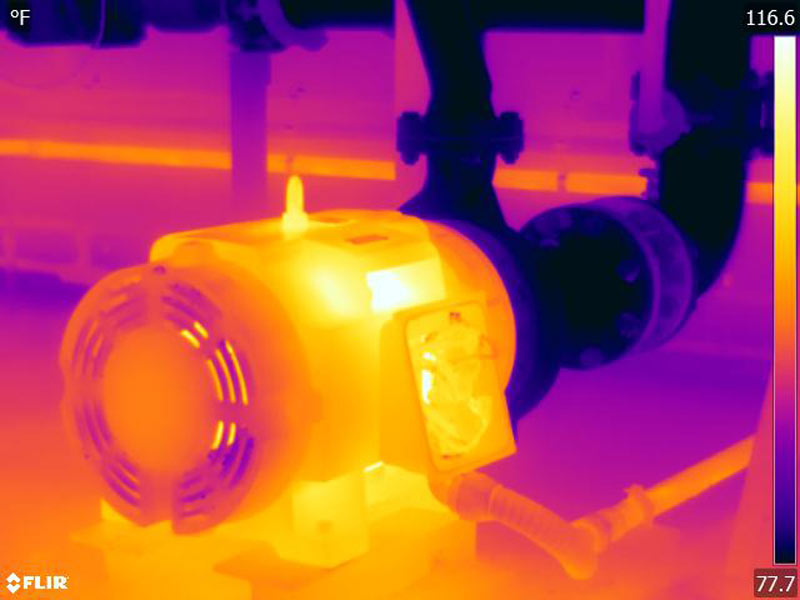
screen. The result is a visual
image based not on light or color but on radiated heat.
For more information, please see the How
Does It Work? page of this web site.
|
|
|
Why
would anyone be interested in infrared thermography?
A heat based image provides valuable
information about the condition of the subject.
A skilled person can determine if the heat patterns are normal or
if there is a problem. With
industrial equipment, a failure while in operation is often preceded by a
period of increasing temperature, especially with electrical equipment. Identifying problems enables scheduled repairs to be made,
thus avoiding the expensive consequences of a failure.
For more information, please see the Why
Infrared Thermography? page of this web site. |
|
|
|
What are the industrial and commercial applications of infrared
thermography?
This technique has many applications such as
industrial electrical systems, furnaces, refractory, locating wet areas in
large flat roofs, identifying heat loss in buildings, security and
surveillance, and medical observations.
At IRIS Associates we specialize in industrial
electrical distribution systems, furnaces, refractory, and building
envelopes. Our principal, Mr.
Maury Confer, has 20 years of experience in this field.
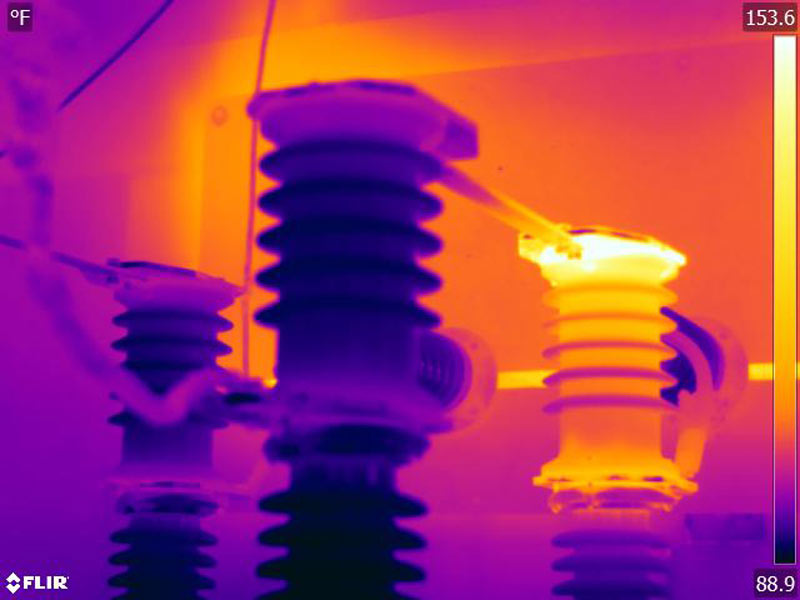
Since you are looking at heat pictures, abnormal
patterns often mean specific things: a high resistance electrical
connection is hotter than other connections under the same conditions,
missing insulation in a building wall will show up as a warm area on the
exterior, a wet area on a flat compound roof is cooler than the area
around it, etc.
For more information, please see the Applications
of Thermography page of this web site. |
|
|
|
How
are the problems found during an infrared thermography survey documented?
With a high quality infrared camera like that used by
IRIS Associates, real time images viewed by the camera are digitally
frozen and stored, then later downloaded to a computer.
Utility software is used view the IR picture, analyze temperatures,
and adjust pictures for optimum clarity.
The temperature of the “hot spot” compared to a reference
temperature often provides valuable information about the severity of the
problem.
The infrared picture is inserted on a form and
accompanied by a detailed description of the location and nature of the
problem, along with other vital information.
A normal visual picture is also included.
The documented problems are included in a report that is used to
direct repair efforts to the equipment in question.
For more information please see the Sample
Report page of this web site. |
|
|
|
Why
should I hire IRIS Associates to perform my infrared survey?
IRIS Associates offers the highest level of service
at competitive prices.
Mr. Maury Confer, the principle at IRIS Associates,
has over 20 years of electrical and mechanical maintenance engineering
experience. This includes not
only infrared thermography inspections, but also a wide range of other
inspection and testing techniques. This
diverse body of experience enables Mr. Confer to bring exceptional insight
and value to your infrared inspection program.
For more information, please see the About
IRIS Associates page of this web site. |
|
|
|
If
an infrared camera sees only heat, why are some images in color and others
in black & white?
The infrared camera senses the amount of heat coming
through the lens from each small element of the picture. It assigns a color (or a shade of gray) to each level of
energy (which is proportional to the temperature).
The camera adds the color since it does not exist in the infrared
world. The end result is that
we see a picture that is based on the heat coming from the subject. |
|